This majestic temple with iconic stupas, elaborate stone reliefs, and awe-inspiring natural landscape is more than just an impossibly splendid sight. Borobudur’s stories, symbols, and revelations are even more fascinating than its magnificent façade. Read more to discover Borobudur, Indonesia’s most beautiful temple.
History
Borobudur Temple shows us a glimpse of what life was like during its time around the 8th-century. During that time the area was governed by the Syailendra Dynasty (meaning Lord of the Mountain) who actively promoted Mahayana Buddhism in the territory.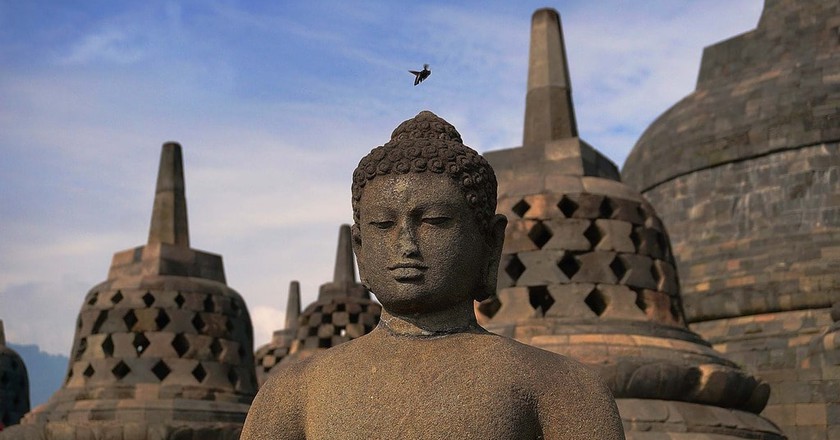 This Buddhist empire built Borobudur Temple during the peak of their influence, a construction that took an estimated 75 years to complete. Built primarily from stones, the temple
was erected block by block without the use of cement or adhesive, but instead using a delicate pattern system to lock one block with each other, all 2 million of them.
This Buddhist empire built Borobudur Temple during the peak of their influence, a construction that took an estimated 75 years to complete. Built primarily from stones, the temple
was erected block by block without the use of cement or adhesive, but instead using a delicate pattern system to lock one block with each other, all 2 million of them.
Symbols and architecture
Borobudur Temple reflects a mixture of Javanese and Buddhist principles in its architecture. The pyramid-like construction of stone bases demonstrates the indigenous beliefs of ancestral spirits that live in elevated places. On the other hand, the Mahayana Buddhist influences are seen in the symbols, forms, and carvings. There are many ways to observe and describe this mystical, symbol-rich construction. Some say it was meant to be a sacred mountain and the dwelling of gods, while others are convinced that the temple is a gigantic textbook of Buddhism philosophies to achieve enlightenment.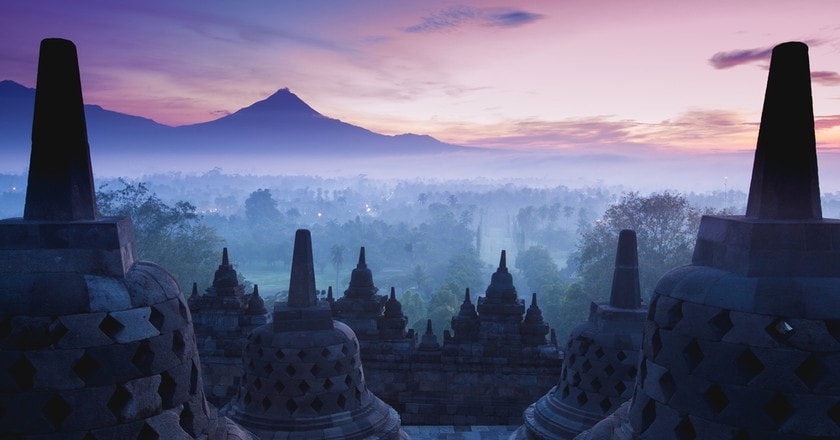 While there are interesting insights in some of those notions, an important way to fathom the significance of Borobudur’s construction is by understanding its ground plan. When
viewed from above, the Borobudur Temple represents the form of a giant, three dimensional Buddhist Mandala, which is a diagram of the cosmos and the human mind. The temple’s three tiers represent the three realms of Buddhist cosmology.
Kamadhatu, or the world of desires is embodied in the pyramidal base of five concentric squares terraces. Rupadhatu, or the world of forms, is represented by the circular platforms above the base. Finally, Arupadhatu, or the formless
world, was manifested in the monumental stupa of Buddha on the top of the temple.
While there are interesting insights in some of those notions, an important way to fathom the significance of Borobudur’s construction is by understanding its ground plan. When
viewed from above, the Borobudur Temple represents the form of a giant, three dimensional Buddhist Mandala, which is a diagram of the cosmos and the human mind. The temple’s three tiers represent the three realms of Buddhist cosmology.
Kamadhatu, or the world of desires is embodied in the pyramidal base of five concentric squares terraces. Rupadhatu, or the world of forms, is represented by the circular platforms above the base. Finally, Arupadhatu, or the formless
world, was manifested in the monumental stupa of Buddha on the top of the temple.